Browsed by
Tag: racing

the long-distance runner is (voluntarily) lonely no more

the long-distance runner is (voluntarily) lonely no more

The backstory to this post is that I wrote it for The SF Marathon’s blog, since I’m a social media ambassador for the race (and totally want you to run it! It’s so fun). I’ve had the great pleasure of having family visiting for about the past month, so between all the wonderful family QT and just general life happenings — all good things, all good things — sitting down (or rather, standing) to write hasn’t been much of a priority. I have notes scribbled out, ready to be made coherent, for a handful of posts, so now that life is back to its regularly-scheduled-programming, perhaps my blog-posting regularity (eh), too, will commence. We’ll see. Anyway — yay running. Here you go; I think many of you (my team! my people) will totally get this.

People often ascribe some element of martyrdom to running. It doesn’t really seem to matter if you’re going for a little jaunt around your ‘hood one morning before work or putting in hours upon hours (and miles upon miles) during training for a half, full, or ultramarathon; for whatever reason, if you willingly run, people seem to think that you’re martyring yourself to a fruitless and futile endeavor, one characterized by literally doing the same thing – putting one foot in front of the other – hundreds of thousands of times.

To say that you’re a runner is to give many people the idea that you’ve taken upon the badge of honor that has begotten runners and joggers alike for the past few decades: a loner, someone who’d rather spend time with his or her thoughts than with other sentient beings. Becoming a runner is to add yet another character to the ongoing saga of “the loneliness of the long-distance runner,” a mythology surrounding our sport since the jogging boom of the 1970s. To be a runner is to live in isolation, away from every_one and every_thing, to be forever an introvert, and to be happiest when being alone.

Except that running isn’t a solitary endeavor. It’s as much a team sport as any out there.

There are so many elements to the running community that seem to have withstood the test of time simply because they’re tradition. It’s practically sacrilege to have anything pre-race but pasta, evidenced by many races’ Marathon Eve pasta feeds, wherein many a runner will stuff him- or herself to the gills with the starchy carbohydrate in part to top off glycogen stores (one can hope) but mostly, I’d guess, out of deference to the tradition. Similarly, many in the running community and those who support us perpetuate this ongoing mythology of “the loneliness of the long distance runner,” conjuring images of runners out there pounding pavement each morning to the tune of … nothing.

While the pasta/carbohydrate loading pre-marathon might have a glimmer of basis in science, I’m calling bullshit on “the loneliness of the long distance runner.”

Thanks to the explosion of social media over the past few years and many runners’ willingness to put themselves and their training out there – creating blogs, twitter and instagram profiles, facebook pages, and creating and maintaining training groups through platforms like Strava, Dailymile, or MeetUp – if you’re a) even minutely connected to the internet and b) a runner, chances are you can easily connect yourself with a team (or three).

Running can, of course, be a solitary and singular endeavor – and many people revel in that quiet time to themselves, a time when they don’t need to stress about their work, family, or any other obligation – but it doesn’t have to be.

Maybe this proclamation is a bit melodramatic, but to run – to be a runner – is to connect yourself with prior millenia’s worth of history, dating all the way back to our earliest ancestors whose lives and livelihoods literally depended on their ability to run. Surely I can’t speak for you, but I think it’s pretty badass to (willingly!) do something our ancestors did so long ago. Not many other sports have been around for nearly the entirety of life as we know it.

Running as a team – running and training with friends – brings with it a lot of practical components that can be beneficial. Of course there’s the accountability aspect – because you’d probably feel like an ass if you left your partner high and dry in the predawn hours, when you’re supposed to be out running – but there are also many other ways that running with a team/with friends can help you, such as giving you more opportunities to run a variety of paces (slower or faster than you’d usually run), which in turn might actually make you a better (read: stronger, faster, fitter, healthier) runner. By actively being involved in a community of runners, you can also forge and cultivate some incredible friendships, and you might also find various avenues to link service with your running, since so many races (including TSFM) give you the option to run on behalf of a charity and to fundraise. It’s a pretty cool thing to be able to use a hobby like running to benefit some social good.

In the absence of physically running in real life with a team, social media can also be an acceptable way to join forces with runners near and far – and in the process, create your own virtual team (and even complete a virtual race, if you’re so inclined). Sometimes  overbooked life schedules preclude us from meeting up with our buddies for a run, but virtual teams – virtual accountability, if you will – can also be a lot of fun. It can get the job done.

When you train alongside someone (in real life or virtually), you’re giving yourself a buddy with whom you can incessantly “talk shop” about training, racing, running, or anything else that’s on your mind. Your team “gets it” – all the highs and lows of training, the momentary boosts of confidence and the crippling effects of anxiety and doubt – because chances are, your team is going through the motions just as much as you are.

Running and training for endurance events invariably give us opportunities to be raw and vulnerable as we set goals and work our asses off to realize them. Having a team is to have a sounding board through every step, every mile, of the process, and in our moments of confidence, anxiety, dismay, excitement, and the entire emotional gamut in between, your team’s got your back. Even when you’re running by yourself – because no one can run your race but you – your team’s in your back pocket.

So many people have run before you, and so many more will come after you. The greater running community is like one big hippy dippy happy family, singing kum-by-yah as we run mile after mile each month, sometimes praising our decision to run for fun and other times wondering what the hell is wrong with us that we’d voluntarily enlist ourselves in such a challenging activity.

In the most non-patronizing way possible: your team gets you. Your team understands. We do this for all the same reasons that you do (give or take).

Runners are a welcoming bunch, and I encourage you to put yourself out there and connect with some, either with clubs in your area or with the virtual running community. I think you’ll be surprised how much more enriching this sport becomes once you realize that yes, while no one else can run your mileage but you, being on a running team isn’t an oxymoron. If there’s any doubt in your mind, just watch the USA women’s Olympic Qualifying Trials from the LA Marathon on 2/13/16. I don’t want to reveal any spoilers (in the off-chance you haven’t already seen the ending), but believe me: the OQT will assure you that running is as team-based an endeavor as they come. I dare you not to tear up.
Two Hours – by Ed Caesar – book review

Two Hours – by Ed Caesar – book review

Though I’ve considered myself a runner for more or less my entire life, well before I broke out my running shoes, I buried my nose in books. In fact, as I think I’ve said elsewhere somewhere on this blog, I have distinct memories of being young (elementary school-aged), and when I’d put out my clothes for school each night, I’d also put out which bookS I was going to bring with me that day. Avid reader is an understatement.

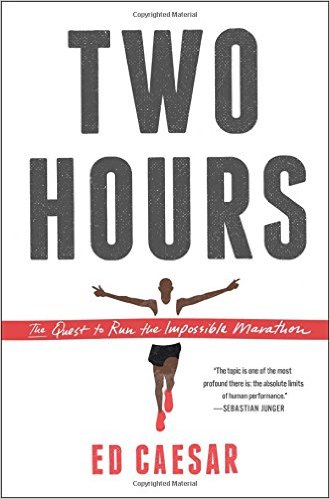
Anyway, it probably comes as no surprise then that for as much as I love to run, I also enjoy reading about running. I recently came upon a new-to-me book, published in 2015 by first-time author Ed Caesar – Two Hours: the Quest to Run the Impossible Marathon. No one sent me this book; I’m not under any obligation to talk about its merits or demerits; I just simply like to talk about running … and books … and books about running.

51kqth8TwxL._SX328_BO1,204,203,200_

The thirty-second synopsis is this: it’s a book about the possibility of a human being – specifically, a male – being able to run 26.2 miles (a marathon) in under two hours (specifically, again, 1:59:59). If you’re not a marathoner and you don’t know how that math computes, allow me: that’s 4:34 minute miles for 26.2 miles.

That’s, really fucking fast.

Like really fucking fast.

More broadly speaking, Two Hours is about the limitations – self-imposed, psychological, physiological, biological, or hell, even socially – of humanity and our potential to overcome them. To say that running a marathon that effing quickly is an exercise in the serious pursuit of a serious unicorn, or an exercise in pushing the bounds of humans’ endurance, is a serious, if not offensive, understatement. This book explores the history of the modern-day marathon as we know it, following along a historical trajectory beginning at what we understand to be the birthplace of the marathon and culminating in modern-day, at the Berlin and NYC ’14 marathons.

Much of the book follows along the fella whom Caesar regards as a prime candidate to come close to that coveted 1:59:59, Kenyan Geoffrey Mutai, who has (among other accolades) the seriously impressive attribute of having run the world’s fastest marathon at Boston ’11 (2:03:02). The heartbreaking caveat here, of course, is that Boston is ineligible for record times (because of the course’s point-to-point setup and because of its net downhill), and to add insult to injury, Mutai also had what some consider an unfair advantage the day that he ran and won Boston – a tailwind for almost the entire 26.2 journey from Hopkinton to Boston.

Caesar expertly intertwines Mutai’s biography with the trajectory of the marathon and its contenders over the years. Included in the story of the marathon of course are other key players over the years – Haile Gebrselassie chief among them, as well as the late Sammy Wanjiru – and how they have influenced the sport and, either directly or indirectly, Mutai, himself. I love this type of writing because it doesn’t really matter if you’re a marathoner or hell, even a runner; it’s just fantastic, seamless, “human interest” type of writing that just so happens to be to the backdrop of marathoning.

Being that it is about running, after all, the book also spends a little bit of time exploring some physiological aspects inherent to running and why, exactly, these details matter – things like an athlete’s VO2 max, altitude-based training, and dietary differences. Even with this “scientific” information, which might immediately turn people off who aren’t in the sport, Caesar still writes about it in a way that makes understanding these aspects’ importance completely accessible to the average reader. In other words, fear not: you’re not reading a double-blind, peer reviewed, scientific journal article about the molecular biology of the world’s best marathoners. Yes, you’re reading about what forces interplay to make two-oh-three-ish guys (marathoners who complete the distance in about 2 hours and 3 minutes)on the biological level but – more than anything – on the societal levels. This key fact is what makes this book so compelling and interesting.

The elephant in the room (book?) here that Caesar didn’t even touch until chapter 8 (of 10) is everything surrounding doping that has engulfed the world of professional running. I can understand this, and at the same time, I don’t. It is horrible that so many professional runners have doped during some of the biggest matches of their lives – cheating themselves but more importantly, the clean athletes who should have won – and unfortunately, more often than not, these allegations don’t appear until years after competition. What really sucks is when an athlete’s country has been riddled with doping allegations and confirmations – as in the case of Kenya – because it implicates clean athletes, perhaps athletes like Mutai, who rightfully earned their wins. Caesar’s chapter on doping illuminates this point head-on as he details how Mutai has been accused over the years of doping – and especially once he became successful year after year at some of the World Marathon Majors.

As a reader, I was expecting Caesar to delve into the doping issues much earlier than he did because like many other running fans, I am unfortunately suspect of amazing, maybe-too-good-to-be-true winning times. Doping sucks for the athletes, no doubt, but it also sucks for fans because it’s no longer easy to just accept our athletes and their talents being the result of hard work and genetics. My point here is just to say that I was surprised that Caesar took as long as he did to talk about doping in the marathoning world, but at the same time, I don’t know if expounding upon the issue any earlier in the book would have made any difference. Damned if you do, damned if you don’t, I guess.

Here’s the biggest takeaway about Two Hours. Yes, it’s a sports book; yes, it’s a book about marathoning; yes, it’s a book about how and when and if a human male, probably Kenyan or maybe Ethiopian, will ever have the biological, physiological, and psychological wherewithal to successfully race 26.2 miles in under two hours, but really, it’s a book about the human condition and experience and how we voluntarily challenge ourselves.

We, as a species, tend to think things are impossible to overcome – we simply can’t fathom it – until one day, we finally do.

The best example: for the longest time, it was impossible – against any sort of scientific or logical knowledge or spiritual feeling – that a male human could run a mile in under four minutes.

A sub-4 mile was impossible until one day, it wasn’t (props, Sir Roger Bannister). And once this suddenly became possible, we as a species started to do it … again. And again. And again.

So many of us, myself included, place self-imposed limitations on what we can do in our running or athletic capabilities (but also probably in other life pursuits, too), and in the process, we shortchange ourselves.

We write our story that says that we can’t do this or we can’t hit this pace, and for worse – not better – that’s what we believe; the story that we ascribe to ourselves is the story we subscribe to, day in and day out.

Though it may be mind-boggling to fathom a human male covering 26.2 miles in under two hours, we are doing ourselves a serious disservice to discount the possibility of it ever happening. It’s like believing that today’s professional marathoners are the fastest and best that they’ll ever be for the rest of time, that there will be no advances in training methodologies, technologies, or any other useful aspect to marathoning in the future that will allow humans to get faster.

We have to be kidding ourselves if we think that humanity is already in its finest and fastest hour.

In case it’s not totally evident, I really enjoyed reading Two Hours in the throes of my marathon training – my first postpartum and thus, my first in over a year – because it leaves me excited for both humanity’s potential performance at the distance and more personally speaking, my own. I have neither the desire nor the talent to ever try to run a sub-2 marathon, but hitting a sub-3 sometime in my life is definitely on my list of big, exciting, scary-ass goals (though I’ve got some work to do first!).

Two Hours is a fast read. Go pick it up, and tell me what you think.